
Miloš Mázor
18. August 2026
Bitcoin as Digital Gold: Can It Protect Savings Against Inflation?
Bitcoin is often described as digital gold, but can it really protect savings from inflation? Explore how its limited supply, growing institutional adoption and high volatility affect its potential as a long-term hedge against currency debasement.
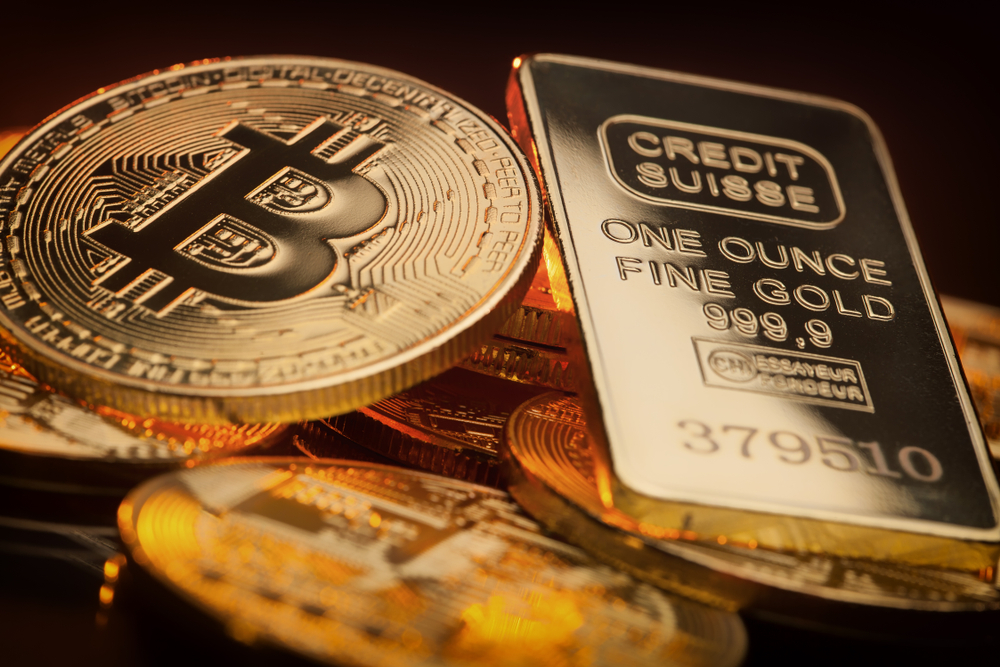
Bitcoin is increasingly being referred to as digital gold. Like the precious metal, it has a limited supply, cannot be created arbitrarily, and is not directly controlled by any central bank. That is precisely why some investors see it as a potential hedge against inflation and the long-term erosion of money's value. Bitcoin, however, is not a classic safe haven, and its ability to preserve purchasing power tends to manifest over longer time horizons rather than during every individual inflationary period.
Inflation poses a subtle yet significant long-term risk to savings. Money held in a current account will not nominally disappear, but over time it will buy fewer goods and services. Households and investors therefore seek assets whose value might grow at least at a pace comparable to the overall price level.
Traditionally, the discussion in this context has focused on real estate, equities, inflation-linked bonds, or gold. In recent years, however, bitcoin has become an increasingly prominent part of the debate. Its proponents argue that thanks to its predetermined limited supply, it can fulfil a similar function to gold — but in a digital environment.
The answer to whether bitcoin genuinely protects against inflation is not straightforward. It depends primarily on the length of the investment horizon, the timing of the purchase, the trajectory of interest rates, the overall conditions in financial markets, and the investor's capacity to tolerate significant price swings.
Why bitcoin is called digital gold
The most important argument in favour of bitcoin is its limited supply — no more than 21 million bitcoins will ever exist. New coins are released into circulation as a reward to miners for verifying transactions and securing the network, with the rate of their creation being reduced by half approximately every four years through a process known as halving.
This fundamentally distinguishes bitcoin from conventional fiat currencies. The quantity of crowns, euros, or dollars in the economy can change based on decisions by central banks and the evolution of credit markets. In times of crisis, central banks may cut interest rates, purchase assets, or support the flow of money into the financial system through other means. Such measures can help stabilise the economy, but at the same time they raise concerns among some investors about the long-term erosion of purchasing power.
With bitcoin, no government or central bank can unilaterally decide to significantly increase the number of newly issued coins. The issuance rules are known in advance, and any fundamental change to them would require broad consensus among participants in the decentralised network. It is precisely the predictability of supply that sits at the heart of the investment thesis that bitcoin can function as a store of value over the long term.
The parallel with gold is also reinforced by the fact that bitcoin is not a liability of any specific company, bank, or state. A share represents an ownership stake in a company, a bond is a claim against its issuer, and money in an account is a liability of the bank. Bitcoin, by contrast, exists within a decentralised network whose transactions are recorded in a shared public ledger known as a blockchain.
Its digital nature also brings certain properties that physical gold does not possess. Bitcoin can be divided into very small units, transferred across borders, and — with proper security — stored without the need for a safe or physical transport. Trading also takes place continuously around the world.
A limited supply alone does not guarantee price appreciation
The fixed number of bitcoins is a powerful argument, but it is not sufficient on its own. The value of any scarce asset depends not only on supply, but also on demand. Even a highly limited item can have a low price if no one wants it.
The investment thesis for bitcoin therefore assumes that demand from individuals, companies, funds, and other institutions will grow or at least persist. If bitcoin continues to establish itself as an alternative investment asset, its limited supply can support long-term price appreciation. However, should investor confidence decline significantly, the cap of 21 million coins alone will not prevent a fall in value.
Gold has the advantage of several thousand years of history in this regard. Beyond its investment and reserve function, it also finds use in jewellery, industry, and electronics. Bitcoin, by contrast, is far younger, and its value is based to a greater extent on the expectation that people will continue to regard it as a scarce and useful asset in the future.
This does not, however, automatically mean that its value is unfounded. The value of many financial assets is created primarily by social consensus, trust, and the willingness of other market participants to accept them. In the case of bitcoin, this trust is tied to the functioning of the network, the limited supply, the ability to transfer value independently, and its resistance to unilateral interference.
Does bitcoin protect against inflation? Research offers a mixed picture
Academic studies have not yet provided straightforward evidence that bitcoin functions as a reliable hedge against inflation under all circumstances. Some research does, however, support its anti-inflationary potential.
A study published in the academic journal The North American Journal of Economics and Finance under the title Bitcoin: An Inflation Hedge but Not a Safe Haven found that bitcoin's price rose in a statistically significant manner following a positive inflation shock. The authors conclude from this that bitcoin can, under certain conditions, function as a hedge against inflation — but not as a reliable safe haven during periods of high market uncertainty.
A more recent study, Is Bitcoin an Inflation Hedge?, reached a similar but more cautious conclusion. Working with US monthly data from August 2010 to January 2023, its results showed that bitcoin's returns rose significantly following an unexpected increase in inflation. The authors simultaneously caution, however, that this property is dependent on the specific economic environment and may change as the market gradually matures.
Particularly important is the distinction between long-term protection against currency debasement and the short-term response to current inflation. Consumer prices change relatively slowly, whereas bitcoin can register sharp gains and losses within a matter of days. In the short term, its price is often influenced by market sentiment, capital availability, the trajectory of interest rates, regulation, or events within the cryptocurrency sector.
Why bitcoin can fall during high inflation
At first glance, it may seem illogical that an asset with a limited supply weakens precisely when inflation is high. The primary reason is typically the response of central banks. When consumer price growth significantly overshoots their targets, monetary authorities generally raise interest rates and restrict the supply of cheap money to the economy.
Higher rates increase the attractiveness of bonds, fixed-term deposits, and other interest-bearing assets. They simultaneously raise the cost of financing and reduce investors' willingness to hold riskier investments. Bitcoin, which generates no interest, dividend, or regular cash flow, may face selling pressure in such an environment.
Its price is therefore often influenced not by inflation itself, but primarily by expectations of what central banks will do in response to it. If the market anticipates a prolonged period of high rates, bitcoin may weaken despite consumer prices continuing to rise. Conversely, if investors expect an easing of monetary policy and greater capital availability in the financial system, bitcoin and other risk assets may find support.
Bitcoin is not the same as a safe haven
The terms inflation hedge, store of value, and safe haven are often used interchangeably, yet they describe distinct properties. An asset can outperform inflation over the long term while being highly volatile in the short term. Bitcoin currently fits most neatly into this category.
A safe haven should hold or increase in value at the moment when other markets are falling sharply. Bitcoin has behaved this way in some crisis situations, but certainly not consistently. More recent research on its behaviour during periods of market stress therefore tends to describe it as a conditional or episodic safe haven, one that may function only during certain phases of financial stress.
As a long-term store of value, bitcoin has more compelling arguments. Its supply is limited, the rules of issuance are predictable, and the asset is not directly tied to the performance of a single company or state. It also has a global market and can be held independently of traditional banking infrastructure.
Bitcoin can therefore be understood more as a riskier digital alternative to gold than as its precise substitute. It offers greater appreciation potential, but the investor pays for this with significantly higher price volatility and a shorter track record.
Institutional interest strengthens the digital gold narrative
Bitcoin's standing has changed significantly in recent years. From an asset traded predominantly by technology enthusiasts, it has become a legitimate subject of interest for asset managers, investment funds, and major financial institutions.
A pivotal moment was the decision by the US Securities and Exchange Commission on 10 January 2024, which approved the listing and trading of several spot bitcoin exchange-traded products. The regulator did not thereby explicitly endorse bitcoin, but it did open a simpler route for investors to gain exposure to its price performance through traditional brokerage accounts.
According to an analysis by the European Central Bank on developments in the crypto-asset market, the entry of traditional financial institutions also contributed to growing interest in crypto assets. The ECB simultaneously warns, however, that increasing integration with the traditional financial system may heighten the risk of contagion from market problems, and that cryptocurrency prices remain highly volatile.
Bitcoin also attracted attention in the Czech Republic. The Czech National Bank announced in November 2025 that it had created a test portfolio of digital assets, which included bitcoin alongside other instruments. The portfolio, with a value of one million dollars, was not created as part of the foreign exchange reserves but as a practical experiment through which the central bank intends to test the processes involved in purchasing, managing, and securing digital assets.
The very fact that central banks and the world's largest asset managers are engaging with bitcoin does not guarantee future price appreciation. It does demonstrate, however, that this is no longer merely a niche technological experiment. Bitcoin has gradually become a distinct asset class that financial institutions monitor, analyse, and in some cases include in their products.
For whom can bitcoin be a suitable investment
Bitcoin may make sense primarily for investors with a longer time horizon, sufficient financial reserves, and the capacity to accept significant price declines. It should not replace money earmarked for everyday expenses, loan repayments, or goals planned for the coming months.
It is more sensible to regard it as one component of a diversified portfolio. Its contribution need not lie solely in direct protection against year-on-year inflation, but also in the opportunity to gain exposure to an asset with a limited supply and an economic structure that differs from traditional currencies, equities, or bonds.
The size of the investment should reflect what level of decline the investor is able to absorb both psychologically and financially. If a significant weakening of bitcoin were to lead to a forced sale or jeopardise a personal budget, the position is likely too large. The long-term potential can only be captured when the investor does not need to exit the market at the first downturn.
To limit the risk of poor timing, gradually investing smaller regular amounts may be more practical than making a lump-sum purchase after a sharp price rally. Regular investing does not guarantee a profit, but it reduces the dependence of the outcome on a single entry point.
Can bitcoin therefore protect savings against inflation?
Bitcoin can form part of a strategy aimed at the long-term protection of wealth against monetary debasement. Its predetermined limited supply, decentralised nature, and growing adoption create conditions under which it may, over a longer period, function as a digital store of value.
It is not, however, a reliable short-term insurance policy against every rise in consumer prices. Its price can fall sharply during periods of high inflation, particularly if central banks are simultaneously raising interest rates and investors are reducing their risk exposure. Existing research therefore suggests that bitcoin's ability to hedge against inflation is more conditional in nature and dependent on the specific period in question.
The most accurate way to view bitcoin is as a potential long-term hedge against currency debasement, rather than as a stable substitute for cash or a savings account. Within a well-constructed portfolio, it can offer an interesting combination of scarcity, global accessibility, and growth potential. The investor must, however, accept that the path to any eventual gains may involve very significant drawdowns.
The content of this article is for informational purposes only and does not constitute investment advice or a recommendation to purchase any specific asset. Investing in crypto assets carries a high level of risk. The value of cryptocurrency assets can fall as well as rise, and you may lose the entire amount invested. Crypto assets are not protected by deposit guarantee schemes. Past returns are not a guarantee of future results.
More articles